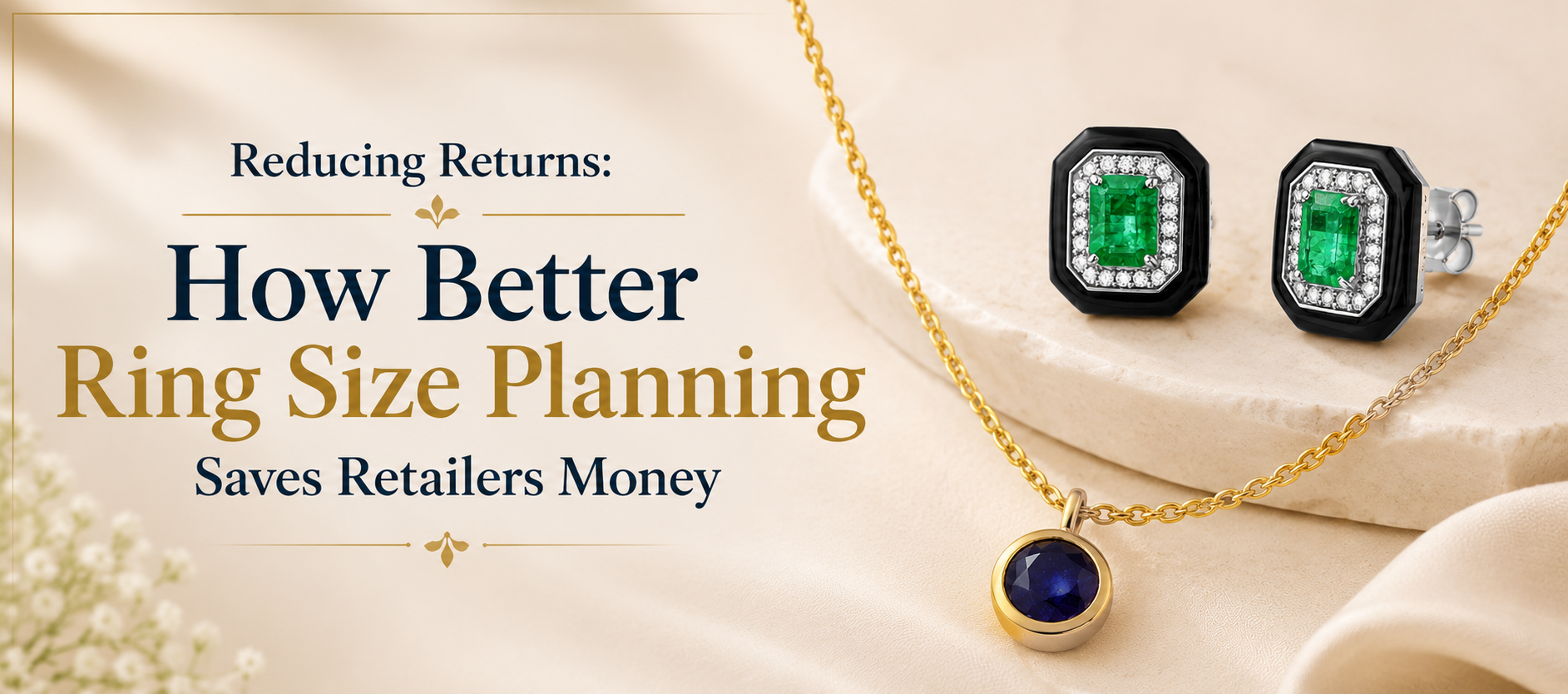
Reducing Returns: How Better Ring Size Planning Saves Retailers Money
A ring that comes back because it doesn't fit costs a retailer far more than the price of a replacement shipment. Between restocking, repackaging, quality re-inspection, and lost selling time, a single sizing return can erase the margin on two or three completed sales. For retailers researching how to reduce returns in jewelry business operations, ring sizing is consistently the largest and most preventable category — and it starts long before a customer ever places an order.
This piece looks at where sizing returns actually originate, what they cost a retail operation in real terms, and the planning steps — from sizing charts to sourcing decisions — that measurably bring the number down.
What Is Ring Size Planning?
Ring size planning is the set of sourcing, inventory, and customer-communication decisions a retailer makes to match rings to the correct finger size before a sale is finalized. It covers size-run selection from suppliers, in-store or digital sizing tools, resizing capability at the manufacturer level, and staff training on measurement accuracy — all aimed at preventing avoidable sizing returns.
Why Ring Returns Happen More Than Any Other Jewelry Category
Ring returns outpace nearly every other jewelry category because size is invisible until the product physically arrives on a finger. A necklace or bracelet has more forgiving fit tolerances; a ring generally does not.
Industry data backs this up. Recent benchmarks put overall jewelry return rates in the 17-20% range, running slightly above the broader ecommerce average, with sizing consistently named as one of the leading causes alongside gemstone color mismatch and gifting misalignment. Ring-specific sizing problems are worse still: industry sources estimate that roughly 15% of rings sold online come back for resizing, and that about one in five of those pieces needs a full redesign rather than a simple adjustment — a distinction that matters because redesign work consumes far more labor and material than a standard band resize.
For a retailer, that 15% figure translates directly into shelf space tied up, staff hours spent processing exchanges, and shipping costs paid twice on the same unit. By comparison, a fixed-length category like a wholesale diamond bracelet line carries far less sizing risk, which is part of why rings dominate the return-reason data in the first place.
The Real Cost of a Sizing Return
A sizing return is rarely a single-line expense. It usually stacks four separate costs on top of each other.
- Reverse logistics. Return shipping, insurance on the returned piece, and receiving labor.
- Quality re-inspection. Every returned ring has to be checked for wear, prong damage, or tampering before it can be resold or resized.
- Resizing or remake labor. Bands can often be adjusted a size or two; eternity settings and pave bands frequently cannot, forcing a full remake.
- Opportunity cost. Inventory sitting in a return queue isn't generating revenue, and staff time spent on exchanges isn't spent on new sales.
Retailers who want a durable answer to how to reduce returns in jewelry business operations need to treat sizing as a supply chain problem, not just a customer service one. That means the fix starts at the sourcing stage, not the return desk.
Where Ring Size Planning Starts: The Sourcing Relationship
A retailer's ability to prevent sizing returns is only as good as the flexibility of its supplier. If a manufacturer only ships fixed size runs with no resizing support, every mismatch becomes the retailer's problem to absorb.
Three sourcing questions determine how much control a retailer actually has over sizing outcomes:
- Does the supplier offer size-run customization at order time? Ordering a spread of sizes based on regional sizing data, rather than a flat default run, reduces the odds of a mismatch before a single unit ships.
- Can the piece be resized after production without a full remake? Solid-band designs typically allow a size or two of adjustment; heavily set or eternity-style bands often do not, and that limitation should be flagged to the retailer before stocking.
- Is private-label or custom sizing available at low minimum order quantities? Retailers testing a new ring style don't want to commit to a large size-run before knowing which sizes actually move.
Manufacturers that build resizing flexibility and low-MOQ customization into their production process give retailers room to correct sizing mistakes without absorbing a full loss — a working example of what direct-from-manufacturer sourcing with private-label flexibility is meant to solve.
The same size-run logic applies outside the ring case, too. A retailer stocking a wholesale gold bracelet collection with adjustable clasps and multiple length options is applying the same forward planning that prevents ring sizing returns, just in a category where the stakes are lower.
Sizing Tools That Reduce Returns Before Checkout
Sizing errors are largely a knowledge gap. Most customers guess their ring size, and guesses are wrong often enough to matter. A few tools consistently close that gap.
Printable and Mailed Ring Sizers
A physical sizer, whether printed at home or mailed to the customer, remains the most accurate self-measurement method available for online buyers.
Sizing Charts With Regional Calibration
US, UK, and EU sizing standards differ. A retailer selling to a US audience should display US sizing prominently and flag conversions clearly if any imported stock uses a different standard.
Virtual Try-On and Visualization
Augmented reality try-on tools don't measure finger size directly, but they reduce style-based returns, which often get miscategorized as sizing issues when a customer isn't sure why a piece "doesn't look right." Retailers offering AR try-on for high-value pieces have reported return rates dropping by roughly 40% on those items.
Staff-Assisted Measurement Guidance
For in-store or B2B showroom sales, training staff to measure at the end of the day (when fingers are largest) and to size up for wide-band styles prevents a predictable category of near-miss returns.
Gemstone categories carry a related version of this problem, since color and clarity expectations set online don't always match what arrives on a customer's doorstep. Sourcing something like wholesale emerald rings from a supplier with documented, batch-level quality control heads off that mismatch before it becomes a return.
Standard Sizing Process vs. Planned Sizing Process
Step | Standard Process | Planned Sizing Process |
Size run ordered | Fixed default run from supplier | Customized run based on regional sizing data |
Customer sizing method | Self-reported estimate | Printable sizer or in-store measurement |
Customer sizing method | Full return and reorder | Resize within supplier tolerance |
Data used for future orders | Not tracked | Return-reason data reviewed monthly |
Tracking Return Data to Prevent Repeat Losses
Retailers that categorize return reasons — sizing, style preference, damage, defect, wrong item — gain a clear signal for where to act. If a specific ring style shows a high sizing-return rate, that's a sign the product page needs a clearer size guide or the supplier's size run needs adjustment. Sellers who review this kind of return data on a monthly cadence tend to spot product-level issues three to four times faster than those who treat each return as an isolated, unrelated event.
This kind of data review is also where vetting matters most. Retailers evaluating designer jewelry suppliers should ask directly about size-run flexibility and resizing policy up front, rather than discovering the gap after return data starts pointing to it.
Expert Insight: What Consistent Sourcing Changes
Retailers working with a single manufacturer across their ring, bracelet, and earring lines gain something that piecemeal sourcing can't offer: consistent sizing standards across every batch. When a supplier controls casting, sizing, and quality control under one roof, size-run accuracy stays predictable order over order, instead of shifting each time a retailer sources from a new vendor. That consistency is one of the more overlooked levers for cutting sizing-related losses, because it removes the guesswork retailers otherwise carry from one purchase order to the next.
Retailers building private-label collections get an added layer of control here. Partnering with custom jewelry designers who support size-specific production runs makes it possible to address the exact variable driving most ring returns, rather than working around a fixed catalog.
A Step-by-Step Framework for Retailers
- Audit the last two quarters of return data and tag every ring return by reason.
- Identify which styles have sizing-return rates above the store average.
- Confirm with the supplier which of those styles can be resized versus which require a remake.
- Adjust future size-run orders based on the sizing data collected, not on default supplier assumptions.
- Add a printable sizer or in-store measurement option at the point of sale for flagged styles.
- Recheck the sizing-return rate after one full sales cycle to confirm the adjustment worked.
Frequently Asked Questions
Why do rings get returned more often than other jewelry?
Rings depend entirely on an exact finger measurement, while necklaces and bracelets have more fit tolerance. A ring that's off by even half a size is often uncomfortable enough to return, which is why sizing consistently ranks among the top return reasons for ring purchases.
Can every ring style be resized after purchase?
No. Solid-band styles can usually be adjusted a size or two without issue. Eternity bands and heavily set pave styles often can't be resized at all, since the stone setting runs around the full circumference of the band.
What's the fastest way to lower sizing-related returns?
Adding a printable or mailed ring sizer at checkout, combined with clear size charts calibrated to US standards, addresses the most common cause of sizing errors: customers guessing their size instead of measuring it.
How does supplier sourcing affect return rates?
A supplier that offers customizable size runs, resizing support, and low minimum order quantities gives retailers room to correct sizing mismatches without absorbing a full loss on each return.
Should retailers track return reasons, not just return totals?
Yes. Categorizing returns by reason — sizing, style, damage, defect, wrong item — shows retailers exactly which product pages, size runs, or suppliers need adjustment, rather than treating returns as a single unexplained cost.
Retailers scaling order volume have another option worth testing first: working with customized jewelry vendors that offer low minimum order quantities makes it possible to trial a size-run strategy on a smaller batch before committing to a full reorder.
The Bottom Line
Sizing returns are one of the few loss categories a retailer can actually plan around rather than just absorb. The combination of accurate sizing tools at checkout, resizing-capable ring designs, and a sourcing partner that supports flexible, low-MOQ size runs addresses the problem at its source instead of managing it after the fact. Retailers who track return reasons and adjust size runs accordingly tend to see the sizing-return category shrink measurably within a sales cycle or two.
-
Gold Filled vs Gold Plated vs Solid Gold: What Retailers Need to Know
August 22nd, 2026 -
 August 22nd, 2026
 -
 July 28th, 2026