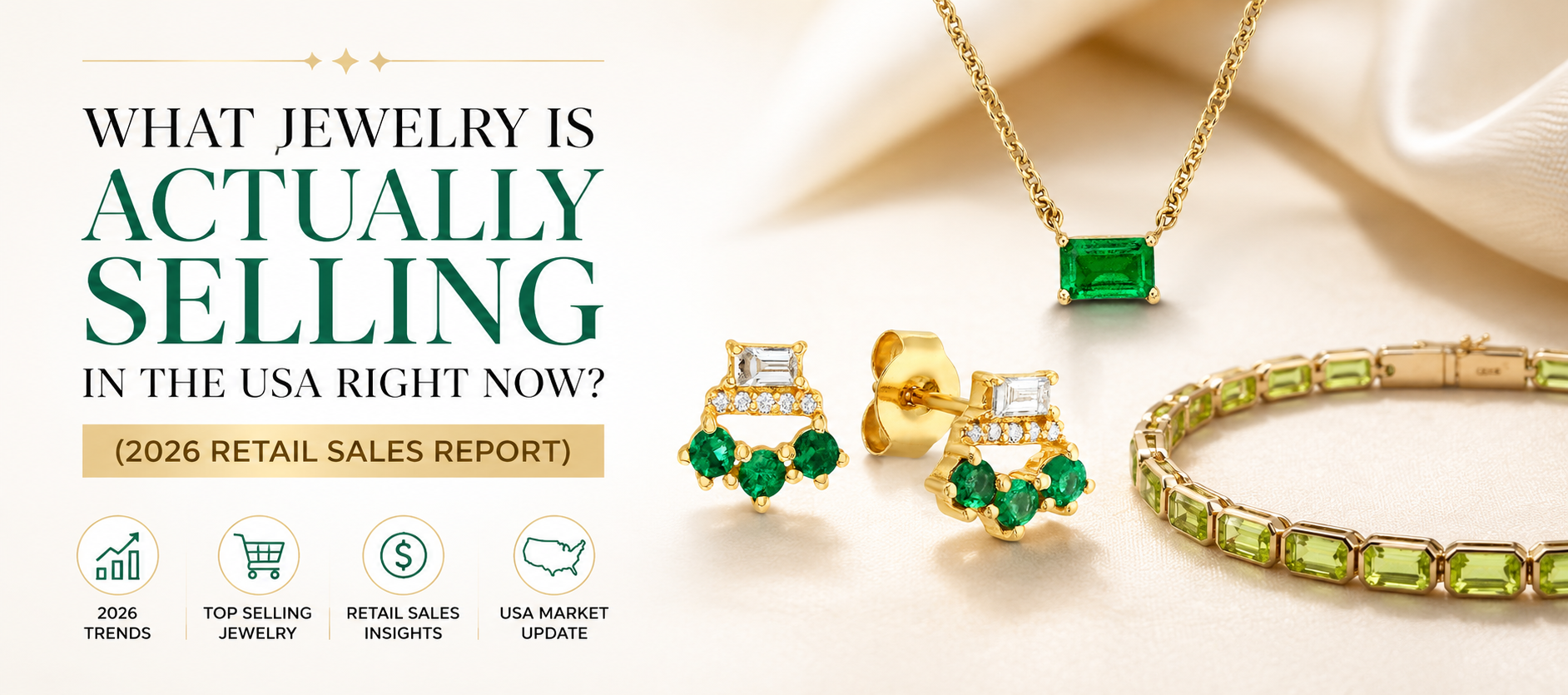
What Jewelry Is Actually Selling in the USA Right Now? (2026 Retail Sales Report)
Walk onto a jewelry sales floor in New York today and you'll notice something the Instagram feeds don't show you: shoppers are buying less, but spending more per piece. Gold sits above $4,000 an ounce, shoppers are comparing prices across three or four channels before deciding, and yet total jewelry revenue keeps climbing. That contradiction is the real story behind Jewelry Trends 2026 — a market that looks tougher on the surface but is quietly getting more valuable underneath. This report breaks down what's genuinely moving off shelves and out of wholesale showrooms right now, based on current U.S. retail sales data, so retailers, buyers, and distributors can plan inventory with facts instead of guesswork.
A Quick Snapshot of the U.S. Jewelry Market in 2026
American households spent north of $106 billion on jewelry last year, though brick-and-mortar jewelry stores captured only a portion of that figure, with the rest flowing through department stores, online-only retailers, marketplaces, and specialty boutiques. Dedicated jewelry stores are projected to bring in roughly $60 billion in 2026, even as the broader industry adjusts to record-high metal costs. Rising gold prices have squeezed margins across the board, pushing many manufacturers toward lighter designs, 14k and 10k alloys, and vermeil alternatives to keep price points accessible without sacrificing craftsmanship. Despite that pressure, the overall U.S. jewelry market is still expanding at a steady annual pace, driven less by volume and more by what shoppers are willing to pay for a single, well-chosen piece.
Fewer Purchases, Bigger Price Tags: The Premiumization Story
The clearest theme shaping this year's numbers is "premiumization." Total jewelry revenue rose sharply in early 2026 even though unit sales for items priced under $1,500 kept shrinking. Meanwhile, demand for higher-end pieces climbed by double digits, and average spend per item followed the same trajectory. Retailers describe it as a "fewer, better things" mindset — customers are buying with intention rather than impulse, and they expect a piece to feel meaningful before they'll open their wallet. This bifurcation, sometimes called a K-shaped consumer pattern, means affluent buyers keep spending confidently while price-sensitive shoppers stretch their budgets further and shop around more before committing.
Diamond Studs and Fine Jewelry Basics Are Outperforming Expectations
Among finished diamond jewelry, stud earrings and wedding sets posted some of the strongest year-over-year revenue gains this year. Buyers are gravitating toward pieces that work every day rather than sit in a box for special occasions, which is why classic, wearable diamond studs continue to sell consistently across price tiers. For retailers stocking their counters, wholesale diamond stud earrings remain one of the safest, highest-turnover categories to build a collection around, since they appeal to both self-purchasers and gift buyers year-round. Beyond studs, diamond strand necklaces — traditionally a slow-moving niche — more than doubled in sales, showing that shoppers are willing to trade up when a design feels fresh rather than formulaic. Retailers rounding out this category are also seeing steady reorders on huggie hoops and drop styles, which is why a broader wholesale diamond earrings assortment tends to outperform a studs-only inventory strategy.
Necklaces, Pendants, and the Layering Obsession
Necklaces are projected to be one of the fastest-growing categories through the rest of the decade, and the reason is simple: they move effortlessly between casual and formal wear. Minimalist chains, layered stacks, and pendant-style designs are dominating both counter sales and online searches, as shoppers build personal "signature" looks rather than buying one statement piece. Personalization is a major driver here — initials, birthstones, and symbolic charms are pulling strong conversion because they turn a generic necklace into something emotionally specific. Retailers looking to capture this demand are finding that a well-curated range of wholesale diamond pendants sells faster when it's organized around these personalization themes rather than displayed as a generic catalog. The same logic extends to finished chains: a tightly edited wholesale diamond necklace collection, spanning delicate everyday pieces to bolder statement designs, gives customers reasons to buy more than once.
Bracelets Are Quietly Having a Breakout Year
Bracelets don't always get the spotlight in trend reports, but the data tells a different story. Tennis bracelets posted double-digit demand growth this year, right alongside wedding sets, making them one of the standout performers in fine jewelry. Much of this momentum comes from the stacking trend — shoppers are buying multiple bracelets at once to layer across the wrist rather than choosing a single piece, which naturally lifts average order values for retailers who merchandise them as sets. A well-stocked wholesale diamond bracelet range pairs naturally with this behavior, especially when tennis styles are offered alongside more casual line bracelets. Mixed-metal styling is reinforcing the same pattern in gold, where a versatile wholesale gold bracelet selection, available in yellow, white, and rose finishes, lets customers build a stack instead of a single purchase.
Bridal Jewelry and the Lab-Grown Diamond Shift
Bridal remains the anchor category for fine jewelry retailers, but how couples buy into it has changed dramatically. Lab-grown diamonds now account for nearly half of all engagement ring sales nationwide, largely because they cost significantly less than mined stones, letting buyers choose noticeably larger center stones for the same budget. That price advantage is pulling more first-time buyers into the fine jewelry category altogether rather than pushing them toward cheaper fashion alternatives. Platinum is also seeing a resurgence within bridal and is expanding into everyday, non-bridal pieces, with retailers reporting strong growth outside the wedding aisle. For manufacturers and retailers alike, this means bridal assortments increasingly need both natural and lab-grown options, presented with equal craftsmanship and equally reliable quality control.
Men's Jewelry Is No Longer a Niche Category
One of the more understated shifts this year is the rapid rise of men's jewelry, now widely considered the industry's fastest-growing segment. Chains, signet rings, bracelets, and layered pendants are moving from niche menswear boutiques into mainstream retail assortments, driven by younger male shoppers who treat jewelry as everyday self-expression rather than an occasional accessory. Retailers who previously treated men's cases as an afterthought are starting to give the category dedicated shelf space, and early movers are seeing it pay off in both foot traffic and average transaction size.
What's Fueling These Jewelry Trends 2026 Shifts
Several forces are converging to create this environment. Self-purchasing is now a primary revenue driver rather than a side effect of gifting season — shoppers aren't waiting for a birthday or holiday to justify a purchase. Social commerce has accelerated discovery cycles dramatically, with platforms like TikTok Shop pushing jewelry sales into the billions and shortening the gap between a design trending online and a customer walking into a store asking for it. At the same time, sustainability and traceability have moved from marketing buzzwords to genuine purchase criteria, especially among buyers under 35 who actively ask where a piece was made and how it was sourced. Layered on top of all this is the ongoing pressure from record gold prices, which is quietly reshaping product design toward lighter settings, mixed metals, and lower-karat alloys without compromising the finished look.
What This Means for Retailers Sourcing Wholesale Jewelry
For retailers and distributors, these shifts translate into a very practical sourcing challenge: customers want fewer pieces, but each one has to earn its price. That raises the bar for consistency, craftsmanship, and design relevance on every single item stocked, not just the hero pieces in a collection. It also means retailers can no longer afford long production delays or inconsistent quality between batches, since a single disappointing piece can undercut the trust that premiumization depends on. Working with a manufacturer that controls quality at the source, rather than relying on multiple middlemen, has become less of a nice-to-have and more of a competitive necessity for retailers trying to protect their margins while keeping up with fast-moving design cycles.
How Retailers Can Stay Ahead in a Shifting Jewelry Market
Retailers who are winning right now tend to follow a similar playbook. They keep a tight, cohesive core collection instead of chasing every micro-trend, they diversify price tiers so both aspirational and budget-conscious customers have a reason to buy, and they prioritize ethically sourced materials because today's buyers ask about it more than they used to. Many are also leaning into personalization and private-label options to differentiate their shelves from big-box competitors selling near-identical inventory. Above all, the most resilient retailers treat sourcing as a partnership rather than a transaction — working with manufacturers who can move quickly on customization, hold quality steady across reorders, and scale production up or down as demand shifts through the year.
Final Thoughts
The U.S. jewelry market in 2026 isn't shrinking — it's getting more selective. Shoppers are trading quantity for quality, personalization for generic designs, and impulse buys for intentional purchases, and every category from stud earrings to statement bracelets reflects that shift. For retailers and distributors, staying ahead means partnering with manufacturers who can match that same standard of consistency, craftsmanship, and speed. As a U.S.-focused, one-stop wholesale manufacturer of gold, diamond, and gemstone jewelry, Alankar Jewels works with retailers navigating exactly this kind of market — helping them source reliably, customize confidently, and build collections that keep customers coming back.
Frequently Asked Questions
What type of jewelry is selling best in the U.S. right now?
Diamond stud earrings, tennis bracelets, wedding sets, and layered necklaces are currently among the strongest performers, driven by consumers prioritizing everyday wearability and personal significance over occasional, statement-only pieces.
Why is jewelry revenue growing even though fewer pieces are being sold?
This is the "premiumization" effect: shoppers are buying fewer items overall but choosing higher-value pieces, pushing average spend per item up even as total unit sales decline, especially for items under $1,500.
Are lab-grown diamonds actually more popular than natural diamonds now?
Lab-grown diamonds have become extremely popular for engagement rings specifically, accounting for a large share of that category, mainly because they let buyers get a bigger stone for a lower price. Natural diamonds still hold strong appeal in finished fine jewelry and gifting.
How are rising gold prices affecting what retailers stock?
With gold trading at historic highs, many retailers and manufacturers are shifting toward lighter-weight designs, lower-karat gold, mixed metals, and vermeil pieces to protect price points without cutting corners on craftsmanship.
Is men's jewelry worth stocking as a retailer in 2026?
Yes. Men's jewelry is currently one of the fastest-growing segments in the industry, with strong demand for chains, bracelets, and rings, making it a category worth dedicated shelf space rather than an afterthought.
-
 June 14th, 2026
 -
 June 10th, 2026